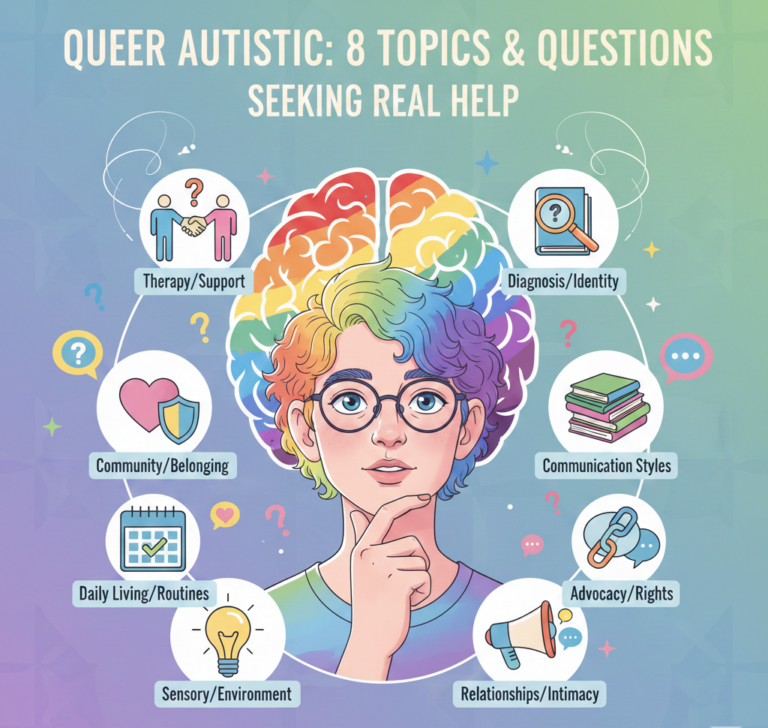
Families come to me in all kinds of seasons, from crisis, confusion, or exhaustion, to fierce love and determination. They don’t call because life is easy. They call because they’re holding a lot trying to figure out how to help someone they love who’s been misunderstood, underserved, or pushed to the edges of systems that were never built with them in mind.
When a loved one is both queer and autistic, the stakes get higher. So does the need for care that actually fits. The wrong provider can cause real harm, while the right one can change the entire trajectory.
I’ve lived this journey and learned from a few angles as an interventionist, as a brother in long-term recovery, and as someone who has been on the receiving end of people showing up when I needed them most. And what I know, without question, is this:
Treatment isn’t a handoff, it’s a powerful partnership.
Families don’t lose their voice when someone starts getting help. In fact, their voices matter even more. You have every right to ask bold, kind, direct questions. You have a responsibility to slow things down, gather real information, and feel your way into the right decision.
Below are questions I encourage families to ask when evaluating any program for a loved one who is suffering from addiction or mental health complications who also has the layered complexity of being queer and autistic searching for safety. These questions aren’t meant to “test” a program, they’re meant to reveal it.
One more truth I’ve learned the hard way: some programs are amazing at marketing and talking about themselves while being terrible at care. Others do beautiful, profound healing work but don’t know how to talk about it.
Your job isn’t to be impressed, but to be informed. You know your loved one better than any brochure ever will and this is your time to step up and advocate, investigate and be thoughtful about the choices being made for your loved one.
LGBTQ+ AFFIRMING CARE
Safety starts with being seen. Your loved one’s identity should never be treated as a side note; it’s part of how they move through the world. When your loved one walks through the doors of a treatment program, their identity shouldn’t be sidelined. Being queer isn’t a sidebar; being autistic isn’t a footnote. These are core coordinates on the map of how they move through the world, how they read a room, regulate emotion, process shame, and experience belonging.
An LGBTQ-affirming program understands that safety includes psychological shelter. It’s about staff who don’t flinch at pronouns, peers who don’t poke or pry, and policies that protect dignity as fiercely as they promote recovery. For someone who has spent a lifetime masking, code-switching, or bracing for bias, affirmation is a life raft. When identity is honored rather than ignored, nervous systems can finally exhale. And when someone feels safe enough to be real, not just compliant, the real work of recovery can begin.
So, when you are interviewing a treatment program, ask this:
- Are staff trained in supporting transgender, queer, and neurodivergent clients, not just “friendly” toward them?
- How are roommate pairings handled?
- Can you request gender-affirming housing arrangements?
- Are there gender-neutral bathrooms and showers?
Dignity isn’t a luxury. It’s a requirement. Programs that serve queer, autistic clients well do so on purpose, not by accident.
AUTISM-SPECIFIC SUPPORT & SKILL BUILDING
Thriving doesn’t happen by wishing for it. It’s built, brick by deliberate brick. For autistic individuals in addiction treatment, support requires thoughtful design and real-world strategy. Autism-specific intervention care goes beyond asking staff to “be patient” and instead equips them to be purposeful. Understanding sensory sensitivities before they become shutdowns, recognizing communication differences before they’re mislabeled as resistance, and teaching concrete coping skills that actually translate outside the therapy room is paramount to success.
These expectations build skills without shaming symptoms. Predictable schedules, clear expectations, and explicit instruction aren’t special treatment, they translate into building confidence, which allows room for recovery to blossom. When treatment programs replace vague encouragement with practical tools, they stop hoping someone will adapt and start helping them succeed.
When strategy replaces guesswork, progress stops being accidental and starts being attainable.
Autism support isn’t just about patience, it’s about strategy.
Ask this:
- What skills do you actually teach? Skills that are going to be important for your loved one:
- Executive functioning
- Communication
- Job readiness
- Independent living
- How is the material delivered? Learning styles matter, and so does information delivery:
- Groups
- One-on-one coaching
- Affirming therapy
- Real-world practice
- Is there support for the things that act as a compass through their life? Things like:
- Emotional regulation
- Social cues and communication
- Problem solving
- Daily living skills like cooking, budgeting, and cleaning
The right program builds scaffolding, not walls, and provides life-long learning opportunities.
MENTAL HEALTH, MEDICAL & CLINICAL SUPPORT
The mind and body don’t live in separate houses, they share the same walls! And when one system shorts out, the whole place flickers. For many queer autistic young adults, depression, anxiety, trauma, and the daily weight of identity stress aren’t passing notions, they are the foundation of every thought and feeling.
These aren’t side notes to addiction, they’re often the score beneath it. A truly capable treatment program knows this and integrates psychiatric care, trauma-informed therapy, and medical oversight with the same seriousness it gives sobriety itself. That means clinicians who understand how autism camouflages distress, how minority stress compounds shame, and how untreated mental health conditions can quietly sabotage recovery.
Medication management isn’t rushed or reactive; therapy isn’t one-size-fits-all. The goal is stabilization with nuance; care with context. When mental health intervention, medical, and clinical support work hand-in-hand, we stop asking someone to compartmentalize their pain and start helping them heal as a whole, complicated, courageous human being.
Ask this:
- Are therapists or case managers on site?
- How many therapy sessions happen each week?
- Is medication management available?
- Do you collaborate with outside providers including gender-affirming medical teams?
Connection is good care. Fragmentation or avoidance is a warning sign.
DAILY STRUCTURE & EXPECTATIONS
Rhythm creates regulation. Repetition creates safety.
For autistic individuals, especially those navigating recovery, daily structure is restorative. A solid treatment program understands that predictability lowers anxiety and that clear expectations reduce the cognitive load of constantly guessing what comes next.
Less about rigid rules, this is about reliable rhythms that help nervous systems settle and focus. Effective treatment meets someone where they actually are, then builds from there with intention. Consistent routines, transparent rules, and advance notice of change turns chaos into something manageable. And when the day makes sense, the work becomes possible.
Ask this:
- What does a typical day look like?
- How much independence is expected?
- How much and what kind of support is built in?
- Is inclusion primary, secondary, or an after thought?
Clarity reduces anxiety for both the client and the family.
HOUSING & PHYSICAL ENVIRONMENT
Environment is intervention. Space is never neutral, it’s either helping regulate the nervous system or quietly overwhelming it. Light matters. Noise matters. Predictability matters. Safety matters. A treatment program can have the best clinicians in the world, but if the environment is chaotic, crowded, or overloads the senses, recovery becomes an uphill climb.
Thoughtful housing considers more than square footage; it considers stimulation. Softer lighting instead of fluorescent glare. Reasonable noise levels instead of constant commotion. Clear boundaries instead of surprise disruptions. When physical spaces are designed with intention, they send a powerful message: you don’t have to be on guard here. And when someone doesn’t have to fight their environment, they finally have the bandwidth to focus on healing.
Ask this:
- What is the housing setup?
- Shared rooms?
- Private rooms?
- Apartment-style?
- Are gender-affirming housing options available?
- Are meals, supplies, and transportation included?
- Are staff present 24/7?
- Are animals allowed? Because sometimes an animal isn’t a pet, but a regulation tool.
The goal is comfort that supports growth, not simply survival.
SOCIAL & COMMUNITY INTEGRATION
Belonging heals in ways no worksheet ever could. It’s paramount to know exactly what programs are available. Connection isn’t just something nice to have in recovery, it is a non-negotiable. Community can be both medicine and minefield, which is why it’s paramount to know exactly what programs are available and how they actually function day to day.
Real integration is intentional inclusion. It’s spaces where differences are understood, not just tolerated, where peers are educated, staff intervene when needed, and no one is shamed for needing distance or structure. A healthy community offers choice, consent, and clarity on when to engage, how to opt out, and where support lives when things get complicated. When people feel they belong without having to perform, compare, or contort themselves, isolation loosens its grip.
And in recovery, that sense of “I’m not alone here” can be as powerful as any clinical tool.
Ask this:
- Are there community outings?
- Volunteer opportunities?
- Job coaching?
- Employment support?
- College navigation?
Many folks are carrying deep wounds of exclusion, isolation and abandonment. You’re looking for a place that actively repairs that, not one that ignores or perpetuates it.
FAMILY INVOLVEMENT
Healing is a team sport. Families don’t need to be perfect. They need to be included.
Recovery doesn’t happen in isolation, and families don’t need to be perfect, just included. Family involvement can be a powerful stabilizer when it’s handled with care, education, and intention. The right treatment program doesn’t blame families or bench them; it brings them into the process with clarity and compassion. That means teaching loved ones how autism shows up under stress, how identity affirmation affects nervous system safety, and how well-meaning missteps can unintentionally derail progress.
Inclusion creates alignment. Alignment creates consistency. And when families learn how to support recovery without trying to control it, healing stops being a solo act and becomes a shared, sustainable effort.
Ask this:
- How often do you communicate with families?
- How is that communication structured?
- How are families involved in treatment planning?
- How often can your loved one communicate with you?
Good programs won’t gatekeep. They invite families in and teach them how to show up in better ways by teaching boundaries, codependency, independence, recovery tools and more. They replace secrecy with education, giving families a shared language instead of shared blame.
When everyone understands their role and their limits, support becomes steadier, healthier, and far more effective.
TRANSPARENCY & TOURING
You deserve to see what you’re signing up for. Up close, in daylight, and without a sales pitch buzzing in your ear. Transparency is a baseline requirement. Ethical programs welcome questions, encourage tours, and answer directly, even when the answers aren’t pretty or polished. They’ll show you the living spaces, explain how rules are enforced, introduce you to staff, and walk you through what a real day looks like.
Surprises can feel like betrayals, and a trustworthy program understands that informed consent is a process. When a facility is willing to open its doors and tell the truth about how it operates, it signals something essential: respect. And respect is where safe, sustainable recovery begins.
Ask this:
- Can I tour the residence?
- Can I observe a group or skills session?
- Can I meet staff and, when appropriate, other residents?
Programs that do good work aren’t afraid of your eyes or your questions.
BOTTOM LINE (AND A LITTLE HOPE)
Your job isn’t to be an expert. It isn’t to be a detective. It’s to be an advocate. Advocacy starts with information. And like people, programs have personalities. Some will be right for your loved one. Some won’t. And that’s okay.
The right place won’t dodge your questions. It won’t rush or pressure you. It w
The right fit will honor your loved one’s identity instead of trying to iron it out of them. It will explain not just what they do, but why they do it and how they adapt when someone doesn’t fit the mold. Because queer autistic individuals don’t need to be fixed; they need to be supported in ways that actually work for their nervous systems.
I tell families this often because I’ve lived it from both sides. I’ve watched what happens when people are finally met with respect instead of resistance or cookie-cutter treatment programs.
When the environment is right, people rise. They learn. They recover. When it isn’t, even the most motivated person will retreat, shut down, or disappear because survival takes precedence over growth.
Ask boldly. Advocate lovingly. Trust your instincts. There are places that honor your loved one’s identity, wiring, voice, and future and they’re absolutely worth finding.